
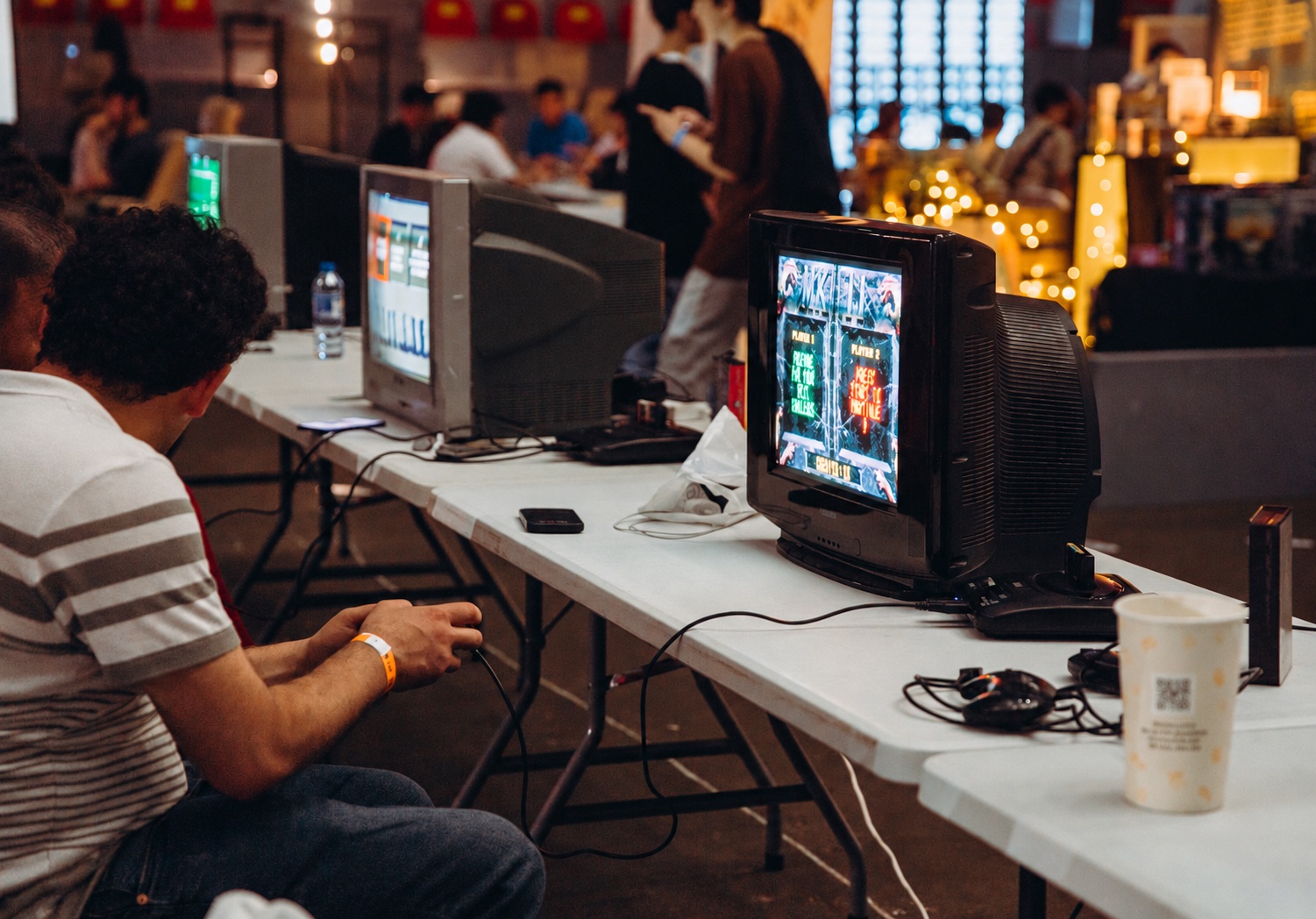
Factorio players learned to drop the first letter of a Czech word just to find a pump.
In November 2024, developer Hrusa explained why: searching for čerpadlo could miss the item named Čerpadlo. The search did not match the accented capital to its lowercase equivalent. Some players worked around it by typing erpadlo. The developer’s account described a fix planned for the next experimental release.
The translated name was there. Finding it was the problem.
That was a historical Czech search bug, not evidence of a current French defect. But it exposes a useful blind spot for a team commissioning French game localization proofreading: a clean text file cannot tell you whether players can use what it says. The review needs the game’s context, and some findings need a developer rather than another rewrite. Start with five interactions: a control prompt, an item search, a dialogue exchange, a changing value and a constrained screen.
Start with the action the player needs to take
Before asking whether a line sounds natural, ask what success looks like on that screen. Does the player need to find an item, follow a control prompt, understand an objective or recognise who is speaking?
This changes the review request. “Please check the French” leaves the reviewer to guess the scope. “Check that the French tutorial lets a new player open the technology screen with their current controls” gives them something observable to verify.
Ask for two separate outcomes: wording corrections, and issues that prevent the wording from working in the build. Keep the second list even when the French itself needs no change. Otherwise, a translator can spend time polishing the sentence while the actual problem remains assigned to nobody.
The same English line may need different French
Sometimes the ambiguity sits in the scene itself. During localization of Return of the Obra Dinn, Lucas Pope sometimes changed a death scene to make what happened clearer and easier to localize. His experience led him to recommend involving the localizer earlier. Before debating the French verb, agree on what the player can actually see happening; a clearer scene may resolve a problem that another wording cannot.
The Battle for Wesnoth documents a concrete reason to supply more than a spreadsheet cell. Its translator instructions use context hints to distinguish a preferences label from a military rank, and dialogue variants for different speakers. A prefix such as female^ is information for the translator; it does not belong in the translated text shown to players.
For your own game, put the speaker, the person being addressed and the purpose of the line beside the text. Grammatical agreement in French depends on the people and things a line refers to. The choice between tu and vous needs an editorial decision grounded in the relationship. A dictionary cannot decide the relationship for you.
Wesnoth’s developer guidance also warns that translation tools may not show strings in their source-file order. “The line above explains it” is therefore a fragile handoff. Attach the explanation to the string itself, using the mechanism your project supports.
When context is missing, ask a question rather than silently settling the ambiguity. Record the answer once and make it available to whoever reviews the next batch.
A control prompt is more than a sentence
Factorio’s localization tutorial gives another useful example. A prompt can refer to the technology-screen control through __CONTROL__open-technology-gui__, instead of writing the default key directly into the sentence. That allows the game to display the player’s configured control.
Replacing that token with a familiar key might make the text easier to read in a spreadsheet. It would also remove the behaviour the token was there to provide.
Keep an explicit list of protected elements, together with the rules for each one. In Wesnoth, a variable such as $gold_amount must remain intact, while a context prefix is omitted from the target. “Never change anything that looks like code” is not precise enough to explain both.
These are different engines with different conventions. Confirm your project’s rules with its developer; do not copy either syntax into another game just because it appeared in a localization article.
Text assembled during play needs attention too. Let the translated sentence determine where a name or number belongs, rather than fixing its position between separately translated fragments. Format strings allow this reordering, and Godot’s official guidance recommends named placeholders. Review the completed French sentence with its real values, not just each fragment on its own.
Choose a small, demanding review pass
If time is limited, begin with a deliberately chosen set of interactions before ordering another pass over every line. This is our suggested starting set, not a complete linguistic QA test plan:
- One tutorial action. Follow the instruction with the default controls, then with a supported reassignment. Check the displayed prompt and what actually happens.
- One item lookup. Search for the French name as displayed. Try relevant case and accent variants, and record which behaviour the team intends to support.
- One dialogue exchange. Read it with the speaker visible and the surrounding lines available. Check relationships, references and tone together.
- One changing value. Inspect the rendered sentence with representative numbers or names. Let the project’s language rules determine the cases; do not assume an English singular/plural pattern covers every target language.
- One constrained screen. Read the actual label, objective or tooltip at a supported display size. Note clipping and confusing line breaks separately from spelling.
Give the reviewer the build version, string identifier and a way to reach each screen. Keep a screenshot of a defect, the steps that reproduce it and the expected result. Without that information, the next person may spend more time finding the issue than fixing it.
Send the finding to the person who can fix it
A useful review does not put every problem in a column called “bad translation.” Use a simple routing decision:
| What you observe | Next step |
|---|---|
| The French changes the meaning or sounds wrong in the scene. | Have the language reviewer propose wording, with the scene attached. |
| The speaker, referent or intended tone is unclear. | Ask the narrative or product owner to resolve the ambiguity before rewriting. |
| The text is right, but a lookup, control substitution or layout fails. | Give the developer a reproducible issue and keep the original wording available. |
After a change, revisit the same screen in the new build. A corrected file and a corrected experience are separate checkpoints. Mark what was actually checked; leave unplayed branches unverified.
This is also a better basis for a quote. Ask whether the price covers text-only proofreading, questions to the team, testing in the game, and a second check after corrections. They are different amounts of work. If a French-speaking human reviewer is required, state that requirement explicitly.
Give the next translation the missing context
The practical lesson is to keep the facts that determine meaning close to the text: who speaks, what the player sees, which terms are settled and which elements the engine controls. Our worked translation brief can help organise that handoff.
Reasoning Translator supports providing audience, tone, context and terms when translating from an original. Those inputs can help you explain the game before generating a French draft. They do not replace a reviewer playing the build, and we have not demonstrated an external game-file import, native human review or guaranteed token preservation here.
The examples above come from public developer accounts and documentation, not a playtest we performed. They establish specific failure modes, not a percentage of games affected or a sales lift from fixing them. Before paying for another blanket rewrite, find out whether your next correction belongs in the French, the brief or the game.